

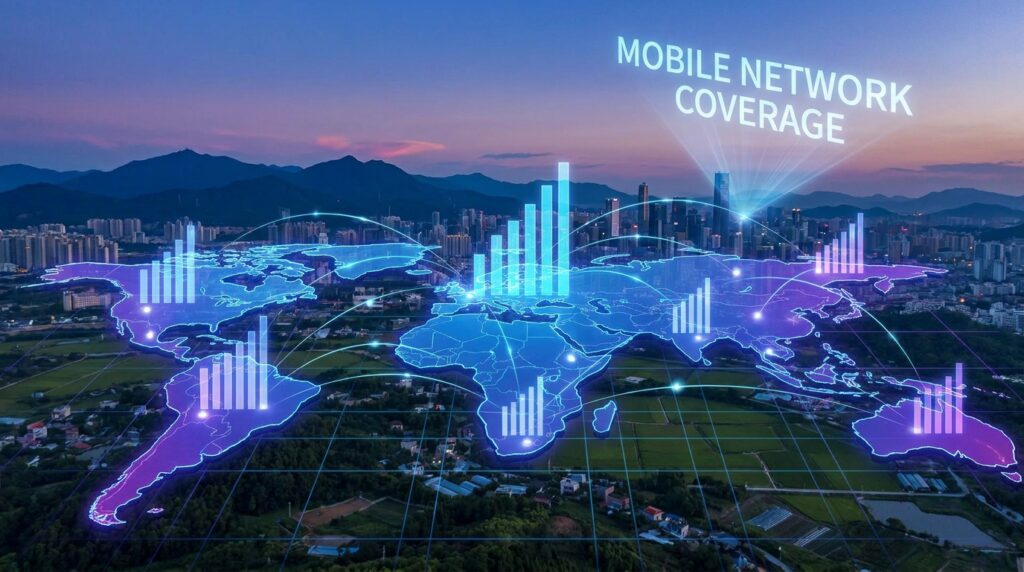
Nearly one billion Africans live right inside mobile network coverage, but they are still not online. The reason has little to do with network towers and everything to do with what a smartphone costs compared to what people earn, that is the core finding from a new report by the GSM Association, the global telecom industry body. The GSMA said closing this gap is now the defining digital inclusion challenge in Africa, even as mobile operators become more central to solving it.
Why Nigerians Are Affected Too
This is not just an “Africa” problem happening somewhere else. Nigeria has been named by the GSMA as one of six African countries, alongside the Democratic Republic of Congo, Ethiopia, Rwanda, Tanzania, and Uganda, selected for a pilot programme to bring affordable 4G smartphones priced at around $40 into the market.
According to the GSMA, this decision reflects both the scale of Nigeria’s digital inclusion gap and the country’s outsized role in Africa’s mobile economy. Despite telecom operators investing heavily in 3G, 4G, and now 5G infrastructure across Nigeria over the past decade, millions of Nigerians remain offline or under-connected, not because the network is not there, but because smartphones remain too expensive for many households.
The GSMA said affordability is the primary barrier in Sub-Saharan Africa, with the cost of an entry-level internet-enabled handset representing 24 percent of monthly income on average in low- and middle-income countries, and rising as high as 80 percent in some areas.
Don't MIss This Article

Other GSMA data puts the regional figure even higher in different calculations. A separate GSMA report found that the cost of a smartphone equals 26 percent of monthly GDP per capita in Sub-Saharan Africa, compared to just 16 percent in other low- and middle-income countries. This pattern in Nigeria is worsened by rising inflation, currency pressure, and low disposable incomes, all of which continue to limit access to entry-level smartphones even as network coverage keeps expanding.
Money is the biggest barrier, but it is not the only one. The GSMA said digital skills and literacy form the second major barrier, especially for people who know mobile internet exists but have not yet started using it. Safety and security concerns, including the risk of online harassment, also discourage many women from getting online, while social norms in more conservative communities continue to shape who in a household gets to use a connected device. A related GSMA study found that this literacy barrier hits Nigeria particularly hard. In Kenya, Mozambique, and Nigeria, more than half of those who are aware of mobile internet but are not using it report problems linked to literacy and digital skills, with difficulties in reading and writing showing up most commonly in Nigeria specifically.
To tackle the cost side of the problem, the GSMA is working through something called the Handset Affordability Coalition. In March 2026, the GSMA announced partnerships to pilot $40 smartphones in Congo, Ethiopia, Nigeria, Rwanda, Tanzania, and Uganda, aiming to close the digital divide across these markets in 2026, around 960 million Africans currently do not use mobile internet despite living within network coverage, which suggests that device affordability, not infrastructure, is the real barrier holding people back. At $40, a 4G smartphone would cost only about 10 percent more than the global average selling price of a basic feature phone, according to Counterpoint Research.
Don't MIss This Article

Hitting that $40 price point is not simple though. Memory chips, which used to make up around 10 to 15 percent of a smartphone’s total cost, now account for 30 to 40 percent, according to a report by market intelligence firm Trendforce, as global memory prices have surged.
The GSMA argues that pricing problems are not only about manufacturing costs. Taxes matter a lot too. According to the GSMA, taxes on entry-level smartphones, which are often classified as luxury goods in national customs schedules, directly push up the price floor for first-time buyers, the GSMA points to South Africa as proof that tax reform works. In 2025, South Africa removed a 9 percent excise duty on smartphones costing less than R2,500, equivalent to about $153, specifically to support digital inclusion for low-income households. This led to a consumer-led jump in entry-level smartphone sales and a drop in feature phone sales as people upgraded. By November 2025, South Africa’s Minister of Communications and Digital Technologies, Solly Malatsi, confirmed the country saw a 16 percent increase in first-time smartphone buyers after the tax was removed. The GSMA has called this reform a model other African countries, including Nigeria, could potentially replicate.
While the smartphone pilot is still rolling out, telecom operators across Africa have already launched their own affordability schemes. In Ghana, MTN partnered with Infinix in March 2026 to launch a phone series on flexible six-month credit terms with 2GB of free monthly data per device. In Kenya, Safaricom’s “Maisha Poa Ni Digital” campaign helped sell over two million devices by May 2025, lifting smartphone ownership on its network from 44 percent to 50 percent of connections. Nigeria has not had a programme on this exact scale yet, but the country’s selection for the $40 smartphone pilot suggests something similar could be coming. MTN, Airtel, and other operators active in Nigeria are part of the wider coalition working on this initiative.
If you or someone in your family is still using a basic phone instead of a smartphone, cost is very likely the main reason, and you are far from alone. Nigeria’s selection for this affordable smartphone pilot means cheaper, internet-capable phones could start showing up in the market as the programme rolls out through 2026.
For now, there is no fixed release date or confirmed retail price for these $40 devices in Nigeria specifically. But the direction is clear: closing this gap is no longer just about building more network towers. It is about making the phone in your pocket something more Nigerians can actually afford.