
Verisign’s Domain Name Industry Brief put the .com domain base at 166.6 million registrations as of 30 June 2026, out of 401.6 million domains across every extension on the internet. That single extension holds roughly 41 percent of everything registered anywhere. When one extension carries that much of the market, the obvious names go early and they go fast.
The number that actually matters to you is a different one, and almost nobody quotes it. Verisign also reports that the combined renewal rate for .com and .net was 75.2 percent in the second quarter of 2026, which means around a quarter of the domains coming up for renewal were not renewed. Millions of .com names fall out of registration every single quarter, so the picture is less “everything is gone forever” and more “everything is gone until somebody stops paying”.
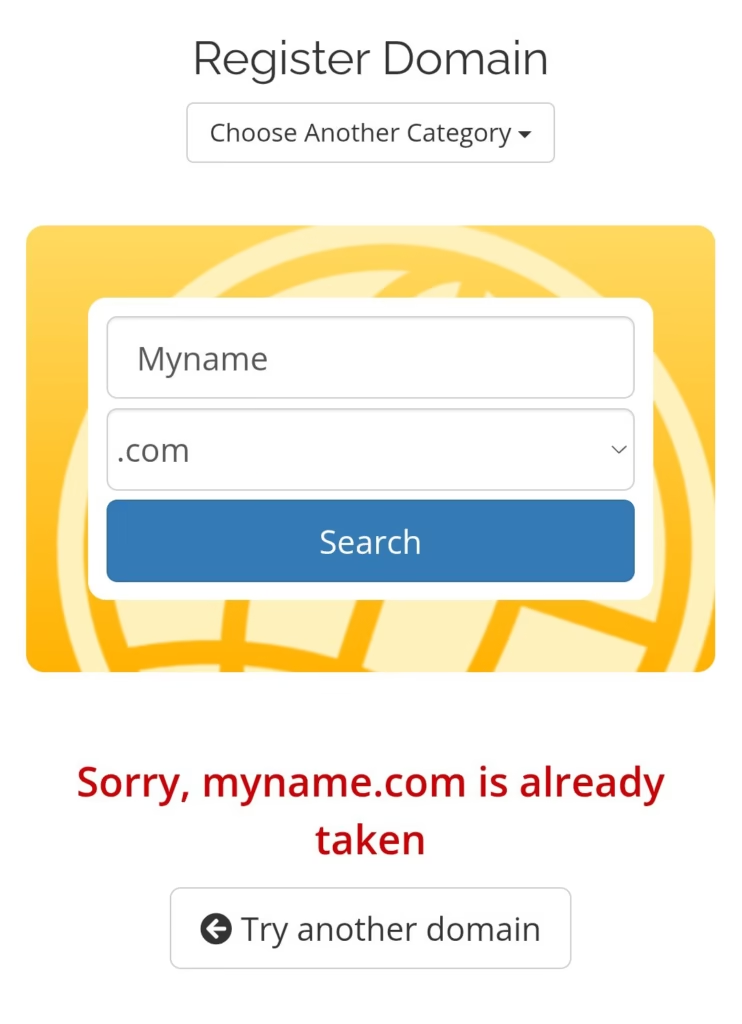
Short names went first and they are never coming back
The maths on short domains is brutal and permanent. There are only 36 possible single-character .com domains using letters and digits, about 1,300 two-character combinations, and roughly 47,000 three-character ones. All of those were claimed decades ago. Four-letter combinations run to about 1.7 million and were exhausted years back, which is why every pronounceable four-letter .com now sits in somebody’s investment portfolio rather than on the open market.
Anything still available in that range trades on the aftermarket for prices that start in the thousands of dollars and climb into seven figures for the genuinely good ones. The squeeze eases considerably once you get past eight characters, and a clear nine to twelve character name is still very much findable. That is not a consolation prize either, since a longer name that reads properly beats a short one that nobody can spell.
The problem is that everyone still wants the same extension
There are well over a thousand extensions available now, including .shop, .app, .ai and .ng, and most people still open the search box and type .com first. The trust factor is real rather than imagined, since people click .com more readily and remember it more easily, and a business with a .com address gets treated as more established whether or not that is fair. Everyone crowding into one extension is what keeps the pressure on it.
What this means practically is that the shortage is concentrated rather than general. A name that is impossible in .com is often sitting free in .com.ng, .ng, .co or .io, and the newer extensions have gained genuine acceptance in tech and ecommerce over the past few years. For a business trading in Nigeria, .com.ng carries a local signal that .com does not, which is an advantage rather than a compromise if your customers are here.
A large share of taken names are not being used at all
Registering a domain does not mean building anything on it. A great many .com names sit parked, held by investors who bought generic or catchy terms years ago and are waiting for someone to make an offer. Others are defensive registrations by companies protecting their brand across variations they will never build on. Neither group has any intention of putting up a website.
Then there are squatters proper, who deliberately register misspellings of known brands or bolt words like “shop” and “deals” onto them, hoping either to sell the name back at a premium or to catch traffic from people who mistype. That is a different activity from investment and in some cases an actionable one, though pursuing it costs more than most small businesses want to spend.
The useful thing about parked domains is that a parked name is often purchasable. Someone holding a domain purely as an asset has a price, and that price is frequently lower than people assume, particularly for names that have sat unsold for years. Checking whether a “taken” domain actually resolves to a real website costs you nothing and tells you whether an approach is worth making.
Names drop constantly, which is where most people stop looking
New .com and .net registrations ran to 12.7 million in the second quarter of 2026 alone, which averages out to well over a hundred thousand new registrations a day. The pool is genuinely under pressure. What that figure hides is the traffic going the other way, because the 75.2 percent renewal rate means roughly one in four names reaching renewal is abandoned by its owner.
Domains that expire go through a grace period, then a redemption window, and then drop back into general availability. Services exist specifically to catch names the moment they drop, and registrars will let you set a backorder on a domain you want so you are in the queue if it becomes free. If a name you want is registered but the site is dead and the registration is old, checking its expiry date through a WHOIS lookup tells you whether waiting is a realistic strategy or a waste of time.
What to actually do when your first choice is gone
Start by widening the length rather than the extension, since a clear nine to twelve character name in .com is usually easier to find than most people expect and avoids the compromise entirely. Add a real word rather than a number, because numbers create confusion the moment someone says the address out loud. Two-word combinations that read naturally still have plenty of room.
If .com genuinely will not work, .com.ng is the strongest alternative for a Nigerian business, and NiRA-accredited registrars handle it at prices well below what a premium .com aftermarket name would cost. Check whether the .com is parked before writing it off, since an approach to a dormant owner sometimes lands. Set a backorder on anything you want that is expiring. And register the name the day you settle on the business idea rather than months later, because good names disappear quickly once an idea starts getting talked about.
The shortage is real and the figures back it up, though the framing most articles use overstates it. Names are not disappearing into a void, they are circulating, with a quarter of them changing hands or dropping every quarter. If you are at the point of picking a name, our guide to creating a blog website in Nigeria covers what comes after the domain, and if monetisation is where you are headed, the AdSense approval strategy is worth reading before you build.