

Three thousand five hundred children and parents descended on Lagos yesterday for the sixth edition of STEM Africa Fest, an annual hands-on science and technology festival that has quietly grown from a pandemic idea into a pan-African movement reaching 25,000 children across seven countries.
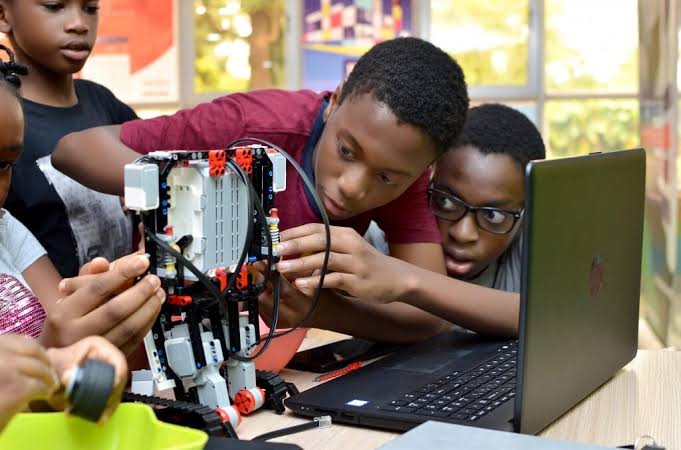
The event, themed “Building Future Innovators,” gave children direct access to experiences most Nigerian school curriculums still treat as theory. At this year’s festival, kids were not just reading about artificial intelligence and robotics, they were using them.
The activities at this year’s edition went well beyond presentations and displays. Children participated in a Rubik’s Cube challenge, an AI masterclass where participants created short AI-generated animations, robotics building sessions, 3D printing demonstrations, and coding workshops.

Jason Lawal, a student of Court Hill College in Opebi, described taking part in the Rubik’s Cube challenge and an AI masterclass where he and other participants created AI-generated animations. Fatima Namama, a student of Greater Ecstasy High School in Iyana-Ipaja, said attending the festival over several years had deepened her interest in laboratory science and technology. She also called for wider integration of STEM education into the school curriculum and more opportunities for students to participate in similar events.
These are not isolated reactions. The organisers say some former participants have returned in recent years as exhibitors in coding and robotics, which suggests the festival is already producing the kind of ripple effect they hoped for when they started it.
Don't Miss This Article

STEM Africa Fest was founded by Titi Adewusi and Jadesola Adedeji, who conceived it in 2021 during the COVID-19 lockdown out of a shared frustration with the gap between what Nigerian classrooms teach and what children actually need to experience.
The maiden edition, held during the pandemic, attracted more than 1,000 participants globally through a virtual format. The first physical edition recorded over 6,000 attendees. Six years later, the festival has expanded beyond Nigeria to Ghana, Sierra Leone, The Gambia, Zambia, Rwanda, and Kenya.
Adewusi explained the founding idea simply. Children were learning theories, and the founders wanted to bring the real thing through hands-on experience. If a child is being taught about 3D printing, the goal is for them to actually experience it. If a child is learning about robotics or AI, the goal is for them to interact with it directly, not just read about it in a textbook.

Nigeria’s STEM education challenge is not a secret. Most public school science labs lack basic equipment. Technology subjects are often taught without the technology itself being present. The gap between what students learn in class and what the global job market actually requires keeps widening.
Adedeji said the festival was born from a desire to make science education more engaging, and that the results have confirmed the approach works. Children who experience technology directly develop stronger and more lasting interest in it than children who only encounter it in a textbook.
The founders have gone beyond the festival itself. They have developed a STEM curriculum that is already being implemented in some schools, and have expressed readiness to collaborate with government to expand its adoption, in line with the United Nations Sustainable Development Goal on quality education.
The message to policymakers at this year’s edition was direct. Both Adewusi and Adedeji called on governments at all levels to strengthen support for STEM education by integrating practical learning into school curriculums, partnering with private organisations to improve access, and going beyond funding to include curriculum development, teacher training, and institutional backing for STEM-focused initiatives.
Ikechukwu Iheagwam, Programme Manager for Sustainability at Access Holdings, who represented the company as a sponsor, said exposing children to emerging technologies such as artificial intelligence and robotics would better prepare them for the future. He added that private sector participation should complement, not substitute for, government efforts in improving STEM education across the country.
One of the more practical decisions the founders have made as demand has grown is to adopt a partnership model. Rather than trying to run every event themselves across multiple countries and states, they now allow collaborators to replicate the programme using an established framework.
Don't Miss This Article

This model makes sense for a growing initiative with limited resources. It lets the festival scale without losing the quality of the experience, as long as partners follow the same hands-on approach that made the original events work.
The organisers acknowledged that funding, stakeholder mobilisation, and expanding to new locations remain the biggest challenges they face. But with seven countries now involved and 25,000 children reached over six years, the case for what they are doing is increasingly hard to argue against.
What started as a response to pandemic boredom and classroom frustration has grown into one of the most visible grassroots STEM education initiatives in West Africa. The children building robots and creating AI animations at yesterday’s Lagos edition are exactly the kind of young Nigerians the country needs to be investing in. The question is whether the government will follow the festival’s lead and make this kind of hands-on learning the norm rather than the exception.