
Nigeria has been ranked among the top five African economies with the most to gain from artificial intelligence. But the same report that delivers that good news also delivers a clear warning: without urgent action on electricity, internet access, and digital skills, most of that potential will stay on paper.

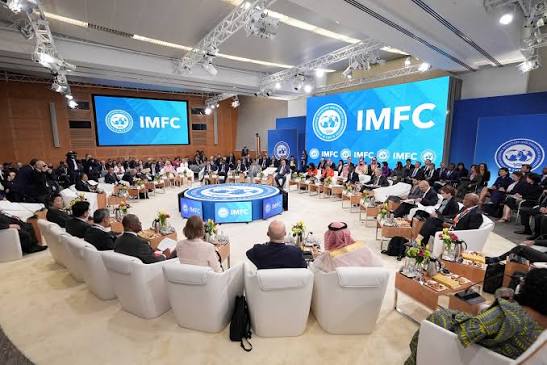
The International Monetary Fund, in its latest report titled “Unlocking the Potential: AI in Sub-Saharan Africa,” listed Nigeria alongside South Africa, Mauritius, Botswana, and Namibia as the region’s top five economies expected to record the strongest AI-driven productivity gains under its baseline projections.
Nigeria’s inclusion in this group is not based on how much AI the country is currently using. It is based on the structure of its workforce. The report said Nigeria’s position reflects its employment structure, with a relatively larger share of workers engaged in sectors such as finance, information and communication technology, and professional services, where artificial intelligence is expected to deliver greater productivity improvements than in predominantly manual occupations.
In plain terms, Nigeria has a large enough pool of workers in desk-based, knowledge-driven jobs to actually benefit when AI tools start doing parts of those jobs faster. That is the foundation the IMF is building its projection on.
The IMF noted that Nigeria’s labour market composition more closely resembles those of emerging market economies than many other countries in the region, making it better positioned to benefit from AI adoption.
The scale of what is on the table for Nigeria and the rest of Sub-Saharan Africa is significant. Artificial intelligence could increase Nigeria’s and sub-Saharan Africa’s economic output by as much as four percent over the next decade if governments accelerate investment in digital infrastructure, skills development, and governance.
But the report is very careful to frame that number as conditional, not guaranteed. Depending on policy choices and AI’s ultimate economic effect, AI adoption in Sub-Saharan Africa could increase productivity between 0.2 percent and 2.1 percent over the next decade, potentially adding up to nearly half a percentage point to annual GDP growth over the same period.
The gap between 0.2 percent and 4 percent is enormous, and it is entirely determined by what governments do next.
Martin Schindler, Deputy Division Chief and Mission Chief in the IMF’s African Department and lead author of the paper, said the scale of what is at stake for the region makes policy action an urgent priority rather than a long-term consideration. Without decisive action, many sub-Saharan African countries could see productivity and growth gains of just 0.2 percent over the next decade. Schindler described that figure as statistically irrelevant.
The IMF was specific about what separates the best-case scenario from the worst case. Three barriers keep coming up throughout the report.

The first is electricity. Around half of sub-Saharan Africa’s population lacks reliable power, and co-author Andrew Tiffin said electricity is the foundational constraint that all other reforms depend on, adding that it is hard to have anything without electricity. AI tools run on data centres and connected devices. Neither works without reliable power.
The second is internet connectivity. AI applications require consistent, fast internet access to function properly. Sub-Saharan Africa ranks lowest on the IMF’s AI Preparedness Index, trailing every global region except South Asia in AI adoption rates, with infrastructure bottlenecks, skills shortfalls, and weak regulatory capacity cited as the primary barriers.
The third is digital skills. Even with power and internet, AI tools are only useful to people who know how to use them. The report argues that training workers and building technical capacity across the region is just as important as laying cables or building data centres.
One area where Nigeria already has a head start is data infrastructure. Africa currently hosts only about 160 data centres, representing approximately 5.5 percent of the global total. Nearly half of these facilities are concentrated in South Africa, Nigeria, and Kenya.
This concentration gives Nigeria a meaningful edge in AI readiness compared to most other African countries. But the report warns it also raises a concern: AI-related investments could become increasingly concentrated in a few countries unless digital infrastructure is expanded across the continent. For Nigeria, the task is building on this existing advantage rather than letting it stagnate.
The IMF’s core concern is not that AI will destroy jobs in Nigeria or across Africa. It is almost the opposite. For sub-Saharan Africa, the central concern is not the risk of technological disruption, but whether countries will be able to adopt, adapt, and scale AI quickly enough to capture its benefits and avoid falling further behind.
As wealthy nations pour money into AI infrastructure and skills, the gap between AI-ready economies and those that are not could widen dramatically over the next decade. Nigeria’s top-five ranking gives it a starting advantage, but that advantage has a time limit.
Being in the IMF’s top five for AI productivity potential is genuinely significant for Nigeria. It reflects the size of the country’s knowledge workforce, the growing tech sector, and the scale of its economy relative to the rest of sub-Saharan Africa. But the ranking describes potential, not achievement.
The IMF concluded that while AI presents a significant opportunity to accelerate economic growth, improve productivity, and enhance competitiveness, Nigeria and other sub-Saharan African economies must prioritise investments in power, broadband infrastructure, digital education, and supportive regulatory frameworks to fully capture the technology’s economic potential. Without such reforms, the region risks falling further behind in the rapidly evolving global AI economy.
Nigeria has been handed a clear road map. Whether the country follows it will determine whether the four percent upside becomes a reality or just a number in an IMF report.