
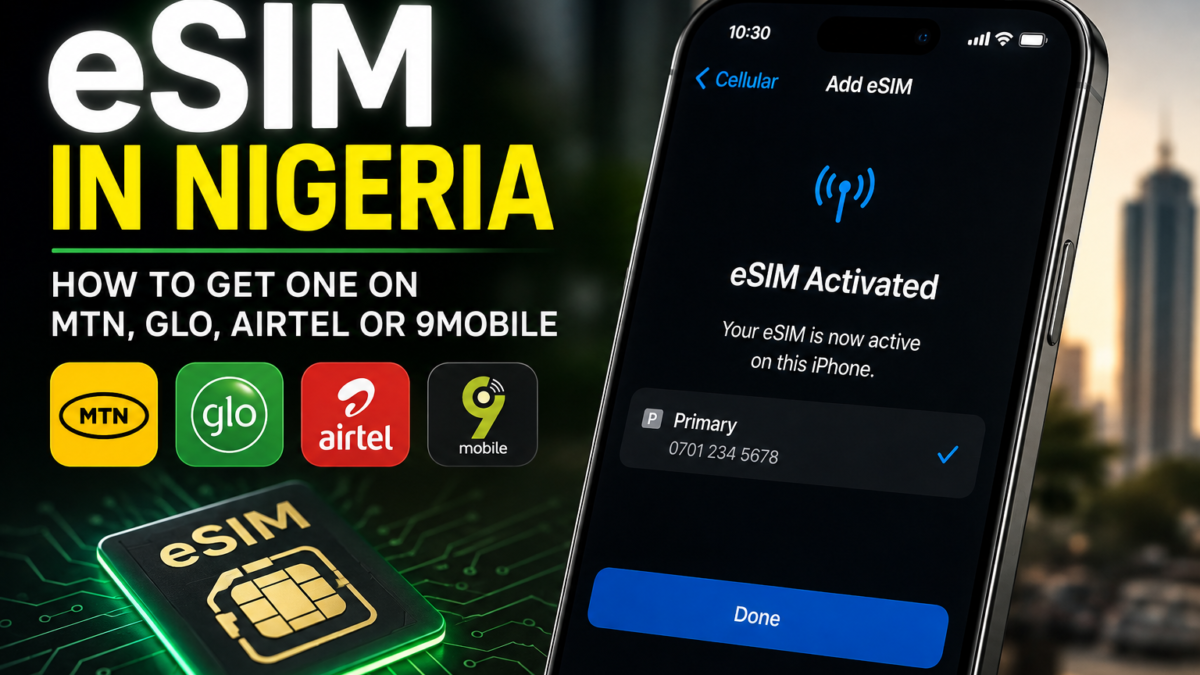
Glo began offering eSIM in March 2025, five years after MTN launched the service in July 2020 and 9mobile followed that August. With Airtel in between, all four Nigerian networks now support it, which makes eSIM a real option here rather than something you read about in reviews of phones sold elsewhere.
An eSIM is a chip soldered into the phone that does what the plastic card does, holding your number and network credentials, except you load it by scanning a QR code instead of sliding it into a tray. Activation is free on the major networks and the line behaves identically once it’s running. What differs is what happens when things go wrong, and that’s the part worth understanding before you convert.
Find out whether your phone can take one
Most Tecno, Infinix and itel models sold in Nigeria don’t have eSIM hardware, and neither do most budget Androids generally, so this is the first thing to establish rather than the last. iPhones from the XS onwards support it, as do Google Pixels from the 3 and recent Samsung flagships, but the answer varies by model and sometimes by regional variant.
The reliable test takes ten seconds. Dial *#06#, which normally shows your IMEI, and look at what else appears. A phone with eSIM hardware also displays an EID, a longer number that identifies the embedded chip. No EID means no eSIM, regardless of what a spec sheet or a seller says.
You can also search “eSIM” in the Settings search bar, or look under Settings > Network and internet > SIMs for an option to add an eSIM. On an iPhone the equivalent sits under Settings > Cellular > Add cellular plan.
Getting one still means a trip to the shop
Every Nigerian network handles this the same way, and none of them let you do it entirely from home. You go to an MTN service centre, GloWorld outlet, Airtel service centre or 9mobile experience centre with the phone itself and valid identification, meaning your national ID, driver’s licence or international passport, plus your NIN.
The agent checks your device is eligible, takes your details, and processes either a new line or a conversion of your existing number from physical SIM to eSIM. Some outlets ask for the IMEI, so having it already noted saves time. Registration applies exactly as it does to a physical SIM, since the NCC’s requirements don’t change because the SIM is digital.
You’ll be given a QR code. Scan it from the phone that’s receiving the eSIM, and make sure that phone is on Wi-Fi or has working data throughout, because the profile downloads over the internet rather than living in the code itself. This is the step people get stuck on, since a phone whose only connection was the SIM you just surrendered has no way to fetch anything.
- Confirm your phone shows an EID when you dial *#06#.
- Go to your network’s service centre with the phone, valid ID and your NIN.
- Request a new eSIM line or conversion of your existing number.
- Connect the phone to Wi-Fi before scanning anything.
- Scan the QR code and wait for the profile to download.
- Label the line, then test with a call and a data session before leaving the shop.
Testing before you walk out is worth the extra two minutes, because sorting out a failed activation is far easier while you’re still standing in front of the person who issued it.
The security argument is stronger than the convenience one
A thief who snatches a phone in Lagos traffic will usually pull the SIM out within seconds, because a SIM in the phone is a SIM that can be tracked and a SIM in the gutter can’t. An eSIM can’t be removed that way. It’s soldered in, so the line stays with the device and stays reachable, which gives you a longer window to lock or locate it.
That same SIM also can’t be moved into a cheap handset to receive your bank OTPs, which is the more expensive half of most phone thefts in Nigeria. For anyone running banking apps on their phone, this is a genuine improvement rather than a marketing point.
The dual-line benefit is real too. An eSIM alongside a physical SIM lets you carry a business number and a personal one, or a second network for when the first has no coverage where you are, without needing a phone with two trays.
Where it becomes inconvenient in Nigeria specifically
Moving an eSIM to a different phone means going back to a service centre. That’s a minor annoyance in a market where people replace phones every few years and a real one here, where keeping a backup handset is common and swapping a SIM into it when the main phone dies, gets wet or goes for repair is routine. With an eSIM, that five-second fix becomes a trip across town during business hours.
You also can’t lend the line out, or borrow a friend’s phone by putting your SIM in it for an afternoon. And if you sell the phone, the eSIM has to be removed properly first, which matters alongside the other steps in our guide to buying and selling used phones without getting scammed.
A sensible middle path is keeping one physical SIM and one eSIM rather than converting everything. Put the number that matters most, the one linked to your bank, onto the eSIM for the theft protection, and leave a physical SIM in the tray for flexibility.
Worth it or not
If your phone supports eSIM, converting your main line is a reasonable move, and the theft argument alone probably justifies it. If your phone doesn’t support it, this isn’t a reason to buy a new one, since the practical difference in daily use is close to nothing.
It is worth checking for when you next upgrade, though, and it belongs on the list alongside band support and update commitments rather than being the deciding factor. Our rundown of the checks worth running before buying a refurbished flagship in Nigeria covers the rest of what to verify, and the wider question of which specifications actually change your daily experience is one we went through in the buying mistakes that waste Nigerians’ money. The Nigerian Communications Commission approved the first eSIM trials here back in 2020, and the registration rules that apply to your plastic SIM apply identically to the digital one.