
Airtel launched the SmartConnect 5G ODU Router in Lagos in September 2025 at an entry price of ₦25,000 with free installation thrown in, and that offer has since changed. The realistic entry cost in 2026 is ₦40,000, made up of ₦25,000 for your first 30 days of unlimited data and a one-time ₦15,000 installation fee. The hardware itself still costs you nothing upfront, though the terms attached to that arrangement are worth reading before you commit.
The product is aimed at a real problem, since Nigerian broadband penetration sits around 43% by NCC figures and fixed-line access simply does not reach most addresses. An outdoor-mounted unit that pulls 5G from a rooftop and feeds it inside is a sensible answer to that, and it works well for a lot of people. We’ll go through what the device actually is, every plan currently on offer, the conditions Airtel attaches to the router, and who this suits.
The outdoor mounting is the whole point of the product
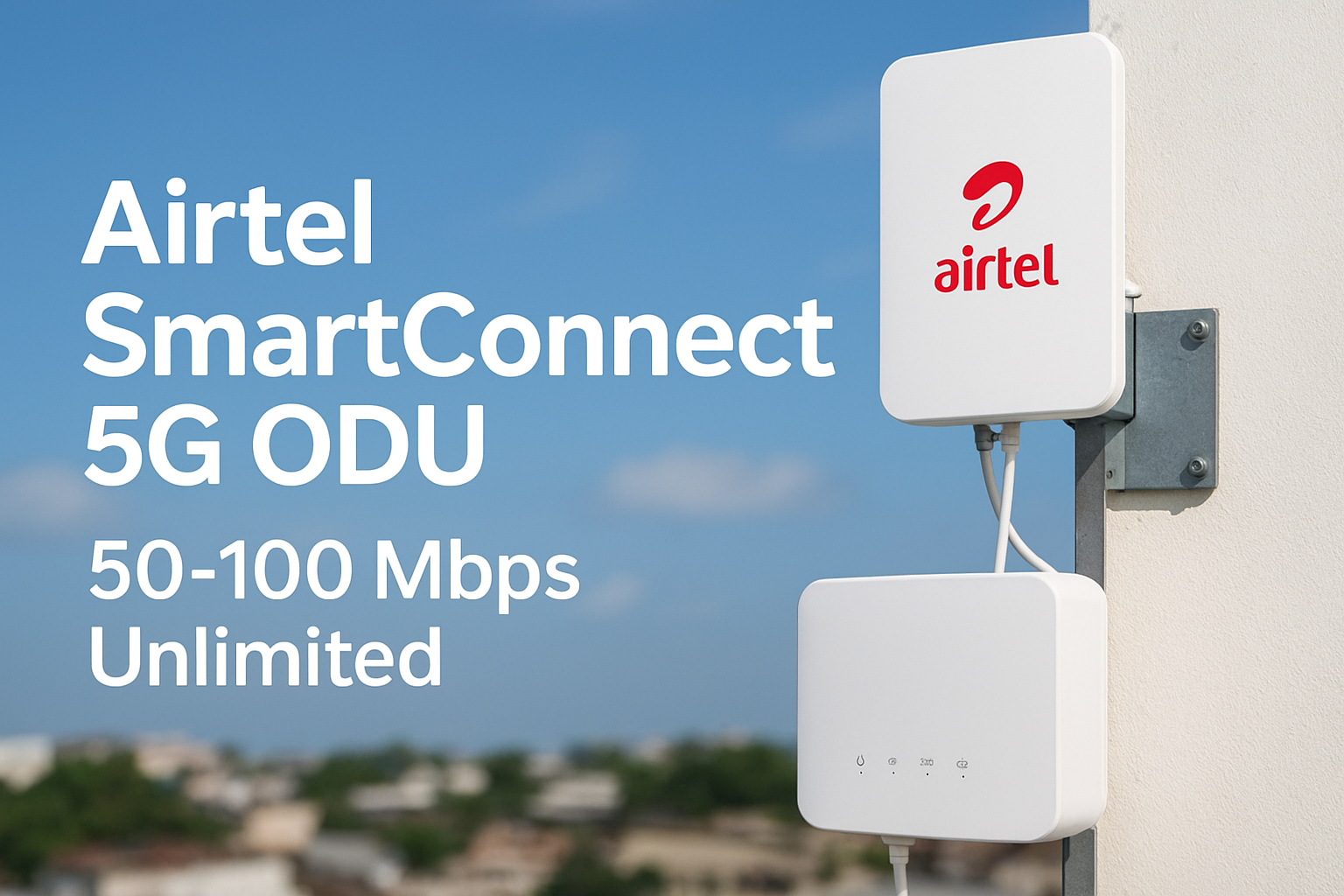
ODU stands for Outdoor Unit, and it describes a weather-resistant device mounted on an external wall, a rooftop or a pole rather than sitting on a shelf indoors. Indoor routers lose a great deal of signal to concrete walls, burglary proof and general obstruction, which is why a phone at a window often shows better speeds than a router two rooms away. Putting the receiving hardware outside where the signal is cleanest removes that problem entirely, and no amount of shuffling an indoor router around the house achieves the same thing.
The unit carries a high-gain antenna with active amplification and connects to Airtel’s 5G network where it exists, falling back to 4G LTE automatically everywhere else. Airtel states support for up to 64 simultaneous device connections, though some listings quote a lower figure of around 32, so treat the exact number as approximate rather than guaranteed. There is a built-in power backup rated at up to six hours, which is the feature Nigerian buyers tend to care about most, since a router that dies the moment light goes is not much of a home internet solution.
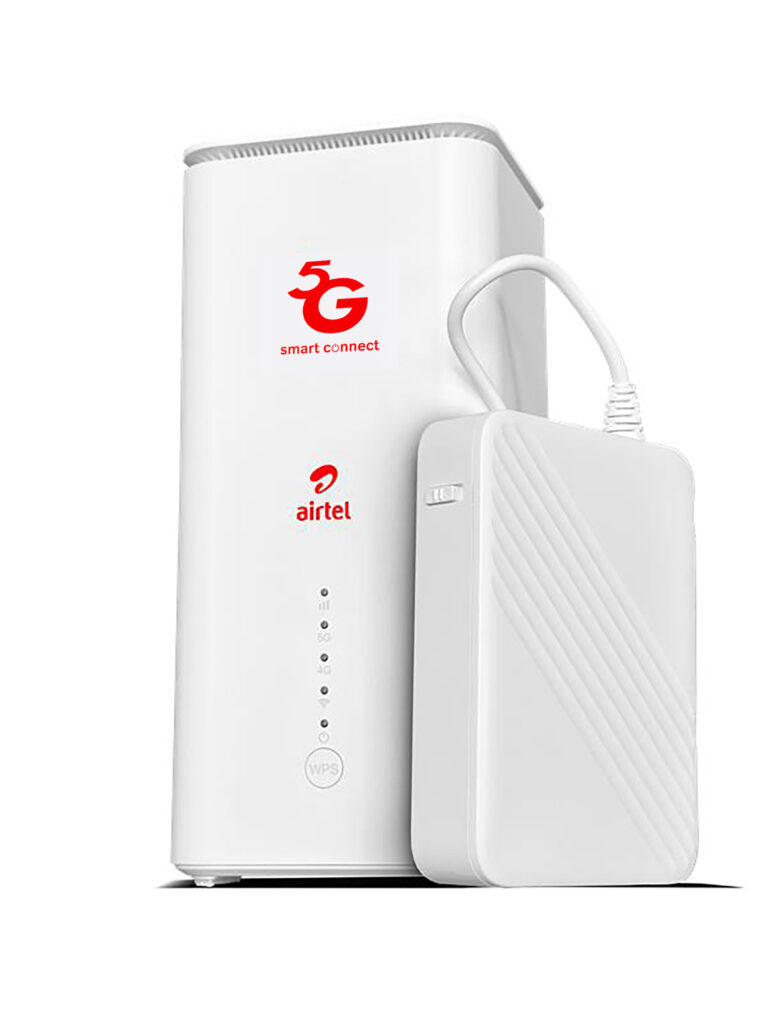
One correction worth making about installation, since a lot of coverage described this as a plug-and-play device. It is not something you set up yourself, and Airtel handles the mounting professionally, which is exactly what the ₦15,000 installation fee now pays for. That also means you should not be climbing onto a roof to reposition it if the connection misbehaves, because adjusting a professionally mounted outdoor unit is a job for Airtel rather than for you.
Every plan on offer, and why the longer ones are cheaper
There are two speed tiers, and each is sold across three validity windows. Committing to a longer window brings the effective monthly cost down noticeably, which matters if you can find the money upfront.
| Plan | Price | Works out at |
|---|---|---|
| Unlimited 50 (30 days) | ₦25,000 | ₦25,000 a month |
| Unlimited 50 (90 days) | ₦67,500 | ₦22,500 a month |
| Unlimited 50 (180 days) | ₦125,000 | about ₦20,833 a month |
| Unlimited 100 (30 days) | ₦45,000 | ₦45,000 a month |
| Unlimited 100 (90 days) | ₦121,500 | ₦40,500 a month |
| Unlimited 100 (180 days) | ₦225,000 | ₦37,500 a month |
The 180-day commitment on the 50 Mbps tier saves you a little over ₦4,000 a month against paying monthly, which adds up to roughly ₦25,000 across the six months. On the 100 Mbps tier the same commitment saves ₦7,500 a month. Whether that is worth locking in depends on how confident you are in the coverage at your address, and there is a case for running a month or two first before paying six months ahead.
Unlimited means unlimited up to a point, and you do not own the router
Two conditions sit behind the marketing and neither is unreasonable, though both deserve to be stated plainly. The plans carry a Fair Usage Policy set at either 1TB or 1.5TB depending on the tier, and once you cross that threshold within a billing cycle Airtel can manage your speeds for the rest of it. For an ordinary household streaming, working and video calling, a terabyte in thirty days is a great deal of data and most people will never reach it. Heavy downloaders and anyone running a business off the connection should know the ceiling exists rather than discovering it in week three. Unused allowance also does not roll over, since these are speed tiers rather than data pools.
The second condition is the more important one, and it was absent from most launch coverage. The router remains Airtel’s property throughout, so you are not buying hardware at any point. If a subscriber stops renewing at the minimum ₦25,000 level for three consecutive months, Airtel can retrieve the device. That is a fair enough arrangement given the hardware costs you nothing upfront, though it does mean the ₦40,000 you pay at the start buys you a service and an installation rather than a router you keep. Anyone treating this as an alternative to buying a MiFi outright should factor that in.
Who this actually suits, and who should think twice
The clearest case for it is a household or small office where fibre has not arrived and is not coming soon, which describes most of Nigeria outside a handful of serviced estates. At ₦25,000 a month for genuinely unlimited use across a whole household, it compares well against the alternative of several people burning through mobile bundles separately. It also suits compounds and shared houses, where the device count and the outdoor mounting let a single connection serve several flats. Our report on 27,685 fibre cuts and 21 million unconnected Nigerians gives a sense of why wireless options keep filling this gap.
The people who should hesitate are those in areas with weak Airtel coverage generally, since an outdoor unit improves reception but cannot manufacture a signal that is not there. Ask about coverage at your specific address before paying, and ask neighbours who already have it rather than relying on a coverage map. Light users are the other group, because someone using 20GB a month is paying ₦25,000 for capacity they will never touch and would do better on a standard data plan, which is the sort of calculation our guide to apps that help you save data in Nigeria is built around.
Field reports on the product have been mixed rather than uniformly good, with speed consistency being the usual complaint and coverage quality at the specific address being the usual explanation. That is the nature of fixed wireless rather than a fault in this particular device, and it is why the first month matters more than the brochure. Take the 30-day plan first, see what the connection actually delivers at your address across a full month including evenings, and only then decide whether a 90 or 180-day commitment is worth the saving.