
Google released Gemini 4 Hydrogen on Thursday, November 12, 2026, and unlike Gemini 4 Argon, which arrived in October for paying subscribers, this one reaches people who don’t pay for Gemini at all. Google says Hydrogen is rolling out to Google Search for all users globally, and it has been added to the Gemini app, where free users get it through automatic model selection whenever a prompt calls for it.
Nigeria is on Google’s list of countries where the Gemini web app is available, so both routes are open to users here without a subscription. In practice, that means the answers you get from Search and from the free Gemini app should start coming from a newer model than the one you were using last week, and Google is pitching it mainly on speed and on making fewer things up.
Free users get Hydrogen, but the app chooses when
In its announcement on the Google blog, the company says Hydrogen now sits in the Gemini app’s model drop-down, while free users are routed to it automatically when the app decides a request suits it. You shouldn’t expect every single reply on a free account to come from Hydrogen, because the app still picks the model behind the scenes.
Hydrogen in Google Sheets starts with Google AI Pro and Ultra subscribers, though, and the same two paid plans are needed to use it inside Google Antigravity, Google’s coding tool. If you only use Gemini for questions, writing and summaries, the free tier is where this update matters most.
Google is selling Hydrogen on speed and fewer invented answers
Google says Hydrogen finishes tasks 2.5 times faster than Gemini 3.8 Flash at its default setting and produces more than five times fewer fabricated claims. On Terminal-Bench 4.1, a test of how well a model handles command-line tasks, Google puts Hydrogen at 57%, against 18.2% for 3.8 Flash. Koray Kavukcuoglu, who leads Google DeepMind’s model work, wrote that “Hydrogen brings cutting-edge intelligence to everyone”.
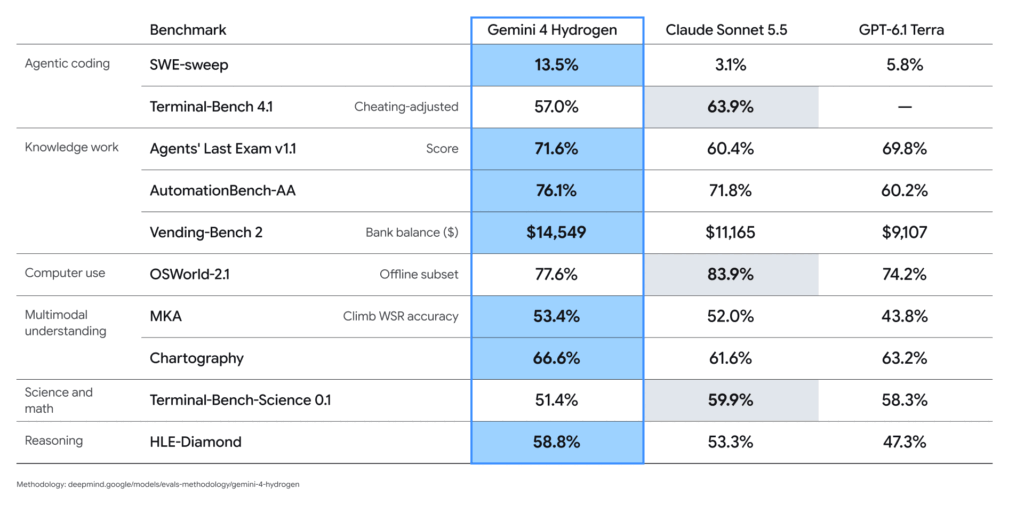
Treat those figures as Google’s own results rather than independent tests, and keep checking anything important that an AI tells you, especially names, dates and figures. The model also comes with four thinking levels, low, medium, high and a new xhigh, with high as the default, which lets apps trade a little speed for more careful answers.
Nigerian developers get a cheaper way into Gemini 4
Hydrogen is available through the Gemini API and Google AI Studio on all tiers, and in Android Studio. Google lists the price at $1.50 per million input tokens and $7.50 per million output tokens, flat across the full one-million-token context window. Because billing is in dollars, what you actually pay in naira will move with the exchange rate and with any foreign transaction charges on your card.
For a startup building a customer support bot or a WhatsApp assistant, that flat pricing makes long conversations and large documents easier to budget for. Anyone who tested Gemini 4 Argon when it reached Nigeria now has a faster, lighter option in the same family for everyday jobs.
If you already use the free Gemini app for work, such as the tools in Gemini’s small business hub, open it over the next few days and watch whether replies come back faster and with fewer errors. That’s the quickest way to judge whether Google’s numbers hold up on the questions you actually ask.