
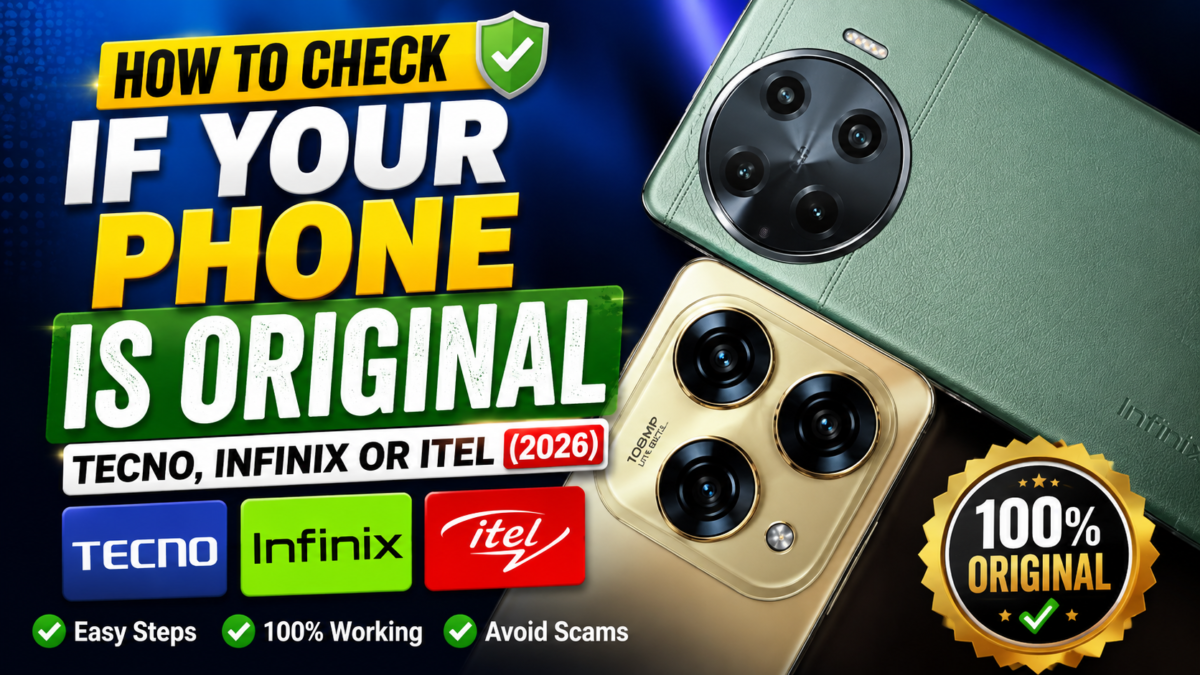
Transsion, the Chinese company behind Tecno, Infinix and itel, pulled in $9.62 billion in revenue in 2024 and sells more phones in Africa than anyone else. That dominance is exactly why cloned versions of these phones circulate so freely in Nigeria. Counterfeiters go where the volume is, and a fake Spark or Hot moves faster in Computer Village than a fake flagship ever could.
The clones have also got better. The days when you could spot one by a crooked logo are mostly gone, and a good copy will show you the right model name, the right storage figure and the right Android version in Settings, because all of that is just text a manufacturer can edit. What a counterfeiter can’t edit is the record sitting on Transsion’s own servers, or the certification Google issues to devices that pass its compatibility tests. Those are the checks worth knowing, and two of them take less than a minute while you’re still standing in the shop.
Start with the IMEI, because three places have to agree
Every genuine phone carries a unique 15-digit IMEI, and on a real device that number appears identically in three places. Dial *#06# on the keypad and it shows on screen. Check the sticker on the box. Then look at the SIM tray or the label under the back cover, where many Transsion models engrave it.
If any two of those disagree, stop there. Cloned devices frequently carry an IMEI copied from a real phone, so the on-screen number may look perfectly legitimate on its own, but the seller had no way to reprint the box sticker to match. A dual-SIM phone should show two IMEI numbers, and if you only get one on a phone sold as dual-SIM, that’s a problem too.
Transsion will tell you itself, free, in about ten seconds
Carlcare is Transsion’s own after-sales service arm, the same company that handles official repairs for all three brands, and it runs a public warranty and authenticity checker. Go to carlcare.com, open the warranty check, and enter the IMEI you got from *#06#.
A genuine device returns a record. You’ll see the model, and you’ll see warranty status. A clone returns nothing, because that IMEI was never issued to a phone Transsion built. This is the single most decisive test available to you and it costs nothing, so run it before money changes hands rather than after.
Read the result carefully, though, because there’s a second thing hiding in it. Transsion counts warranty from the moment the device is activated with a SIM, not from when you bought it. If a phone being sold to you as brand new comes back showing a warranty that started eight months ago, the phone is real but it isn’t new. Somebody has used it, and you’re paying new-phone money for a returned or second-hand unit. That’s a different scam from a clone, and this check catches both.
The Google check that almost nobody in the market knows about
Google certifies Android devices that pass its compatibility test suite, and every legitimate Tecno, Infinix and itel sold in Nigeria carries that certification. Counterfeiters can’t obtain it, because getting certified means submitting real hardware to Google rather than editing a settings page.
Open the Play Store, tap your profile picture, go to Settings > About, and look for Play Protect certification. Certified is what you want to see. Uncertified on a phone sold as new from a mainstream brand means you’re holding a device Google has never seen, and that’s about as close to proof as you’ll get without opening the case.
It’s worth doing this one even when the IMEI checks out, since a clone carrying a stolen IMEI can pass the Carlcare lookup by borrowing someone else’s identity. Play Protect certification is tied to the actual hardware in your hand, so the two tests catch different tricks and you want both.
Make the phone report its own chipset instead of trusting the settings page
Everything under Settings > About phone is editable by whoever built the software, which is why a clone will happily tell you it has 8GB of RAM and a Helio G99. Apps that read hardware directly, like Device Info HW or CPU-Z, pull from the kernel instead, and that’s much harder to fake convincingly.
Install one, note the processor and RAM it reports, then compare against the official specification on the Tecno or Infinix website for that exact model. A phone advertised with a Dimensity chip that turns out to be running an old quad-core Spreadtrum is a clone, whatever the box says. Storage deserves the same treatment, so check Settings > Storage for the total capacity rather than the free space, since a phone claiming 128GB that reports 32GB total has been misrepresented. If you want the fuller version of this process for higher-value purchases, our guide to the checks worth running before buying a refurbished flagship in Nigeria covers the same ground for expensive devices.
What to actually do in the shop, in order
- Dial *#06# and compare the IMEI against the box and the SIM tray.
- Enter that IMEI on carlcare.com and confirm it returns a matching model with an unstarted warranty.
- Check Play Store > Settings > About for Play Protect certification.
- Install a hardware info app and compare the chipset and RAM against the official spec.
- Confirm total storage in Settings > Storage matches what you’re paying for.
Sellers who are confident in their stock won’t mind you doing any of this, and the reaction you get is informative in itself. Anyone who rushes you, insists the phone is sealed and can’t be powered on, or offers a discount to skip the checks has told you what you need to know. The same logic applies to online purchases, where you should insist on the IMEI before paying, and our breakdown of how to buy used phones online in Nigeria without getting scammed goes through the rest of that process.
If you’ve already bought one and it fails these tests
Go back to the seller with the Carlcare result on your screen, because a failed lookup from Transsion’s own service arm is far harder to argue with than your opinion that the phone feels wrong. Many sellers in Computer Village and similar markets are reselling stock they bought in good faith and will exchange it rather than lose the reputation, particularly when you can show them official documentation.
If the phone turns out to be genuine and simply underwhelming, that’s a different situation with different fixes, and it’s worth reading why a new Android phone can still end up being a waste of money before assuming you were cheated. Real Transsion devices also hide a fair amount of performance behind settings nobody turns on, and our look at the battery settings most Infinix owners never find is a reasonable place to start with a phone that checks out but disappoints.
None of this makes buying in an open market risk-free, and a determined counterfeiter with a stolen IMEI and a convincing shell can still get past a casual buyer. But running five checks that take about four minutes puts you well beyond casual, and that’s usually enough, because the people selling clones are counting on nobody bothering.